
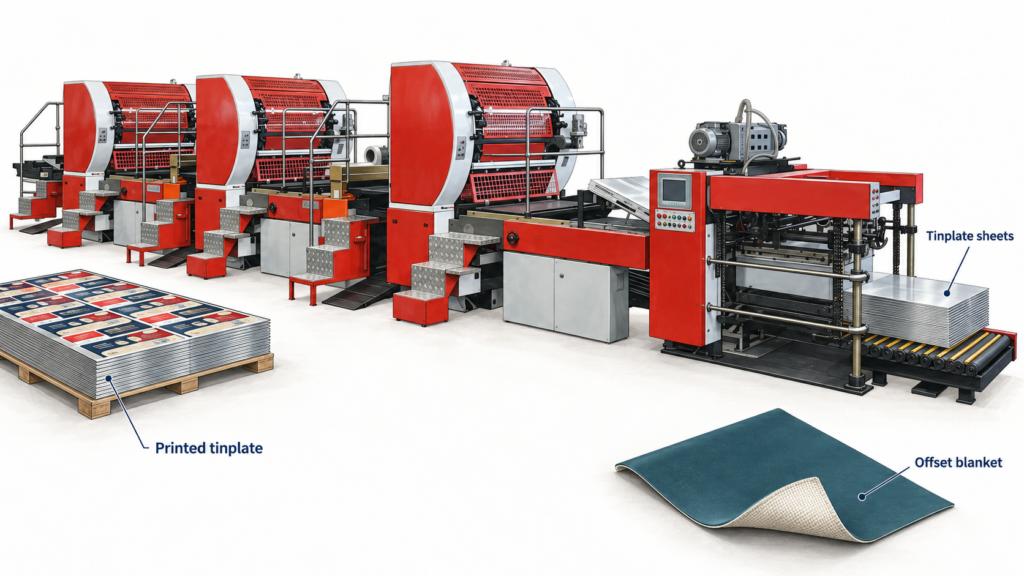
Most of us in metal printing have seen this. A blanket that ran happily on carton board goes onto the tinplate line. Day one looks fine. Then the operator calls you over: there’s a faint line where the sheet edge lands, the white isn’t covering, and the small reverse text is filling in.
Usually there’s nothing wrong with the blanket itself. It just wasn’t made for metal.
An offset printing blanket for tinplate has a harder life than a paper blanket. The sheet doesn’t give, it doesn’t absorb any ink, and its cut edge hits the same spot thousands of times a shift. Here’s what that means on the press, and what to check before ordering.
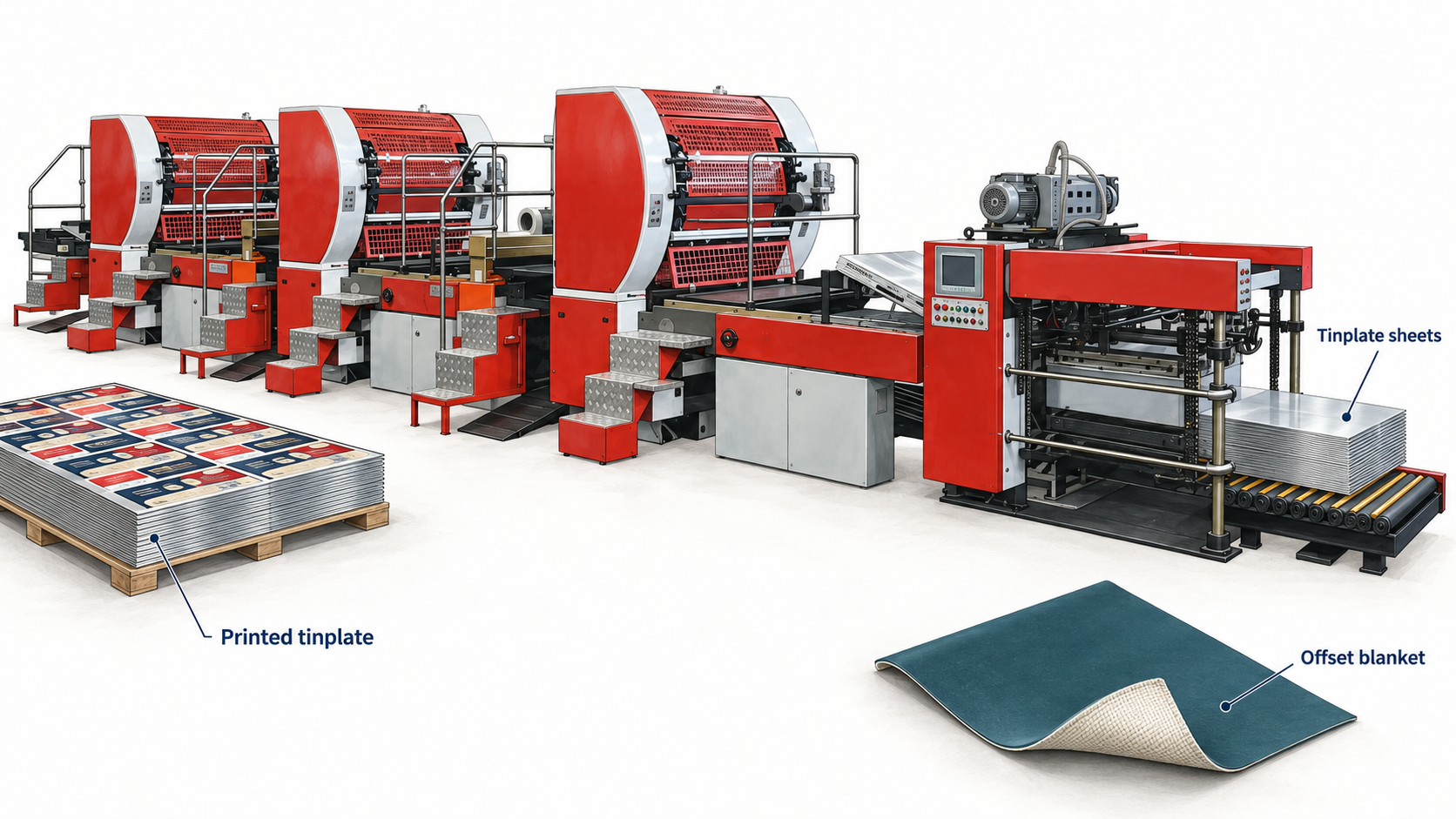
Can you use a paper offset blanket on tinplate?
You can, and on a short run it may even look acceptable. But a paper blanket isn’t designed for a rigid, non-absorbent sheet or for metal edges striking it on every impression. On tinplate you’ll usually see edge marks, patchy solids and early gauge loss, and that costs more in stoppages and rejects than you saved.
An offset printing blanket for tinplate is a multi-ply rubber and fabric blanket, normally with a compressible layer, made to transfer heavy ink films onto rigid metal sheets while standing up to sheet-edge impact and to the inks and washes used in metal decorating.
How tinplate changes the printing conditions
On paper and board, the stock helps you a little. It flexes slightly in the nip, has some surface tooth, and soaks up part of the ink vehicle, so small pressure and ink differences get hidden.
Tinplate doesn’t. The sheet is hard, the coating absorbs nothing, and the ink has to level out on the surface by itself.
So whatever is slightly off ends up on the sheet. A blanket that has lost some recovery, a glazed face, or packing a touch low on one side shows up as mottled solids, smearing, reverse type closing in, or drifting density. On board you might never notice. That’s why a tin plate printing blanket is chosen for the substrate, not just the press.
Why do compressibility and recovery matter more on rigid metal?
With paper, the stock absorbs some of the variation in impression. With tinplate it can’t, so the blanket and the packing take almost all of it. The compressible layer has to squeeze down and come back fully on every revolution. When it stops doing that, you get low spots, gauge loss, and uneven solids, sometimes within days.
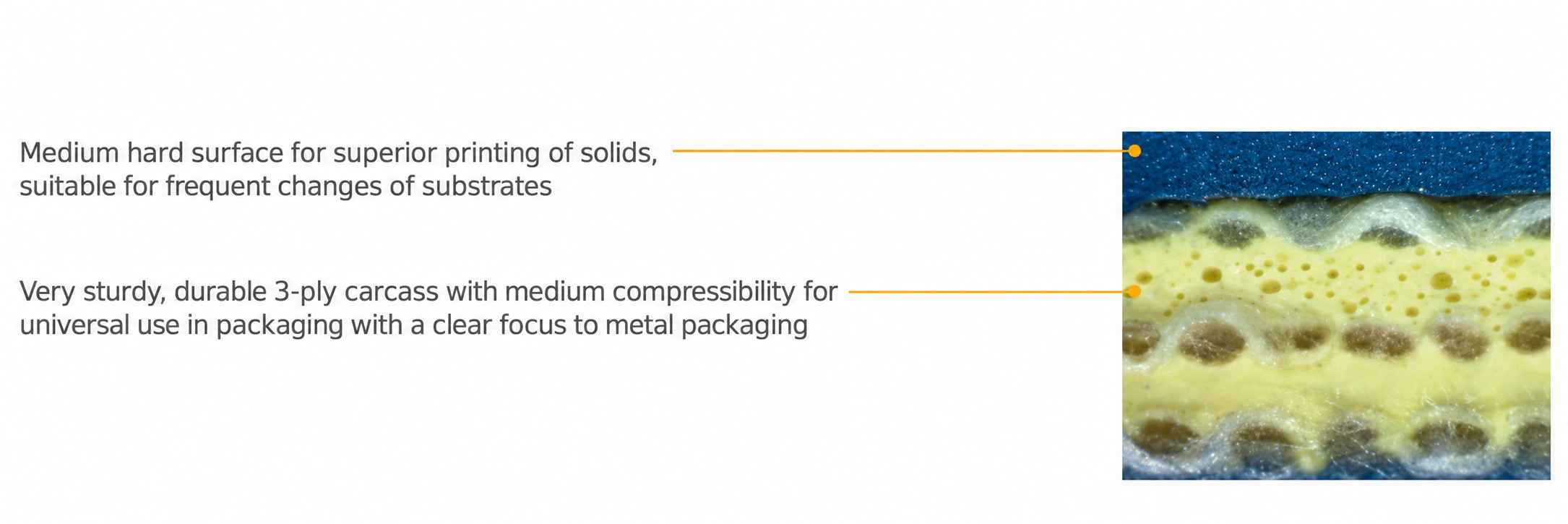
Most blankets made for metal decorating use a closed-cell compressible layer. Picture tiny sealed bubbles that squash under pressure and spring back.
We’re often asked whether a softer blanket is the answer. Not always. Too soft and dots spread. Too hard and the blanket can’t absorb the pressure spike at the sheet edge, which is where metal does its damage. The right point depends on your press, packing, metal, and usual jobs.
Why does a blanket get edge marks in tin printing?
The cut edge of a metal sheet puts impression pressure onto a very thin line. If that edge has a burr, or the sheet size keeps it in the same place, the blanket takes the hit in one spot every impression. Over a long run, that cuts the face and crushes the compressible layer.
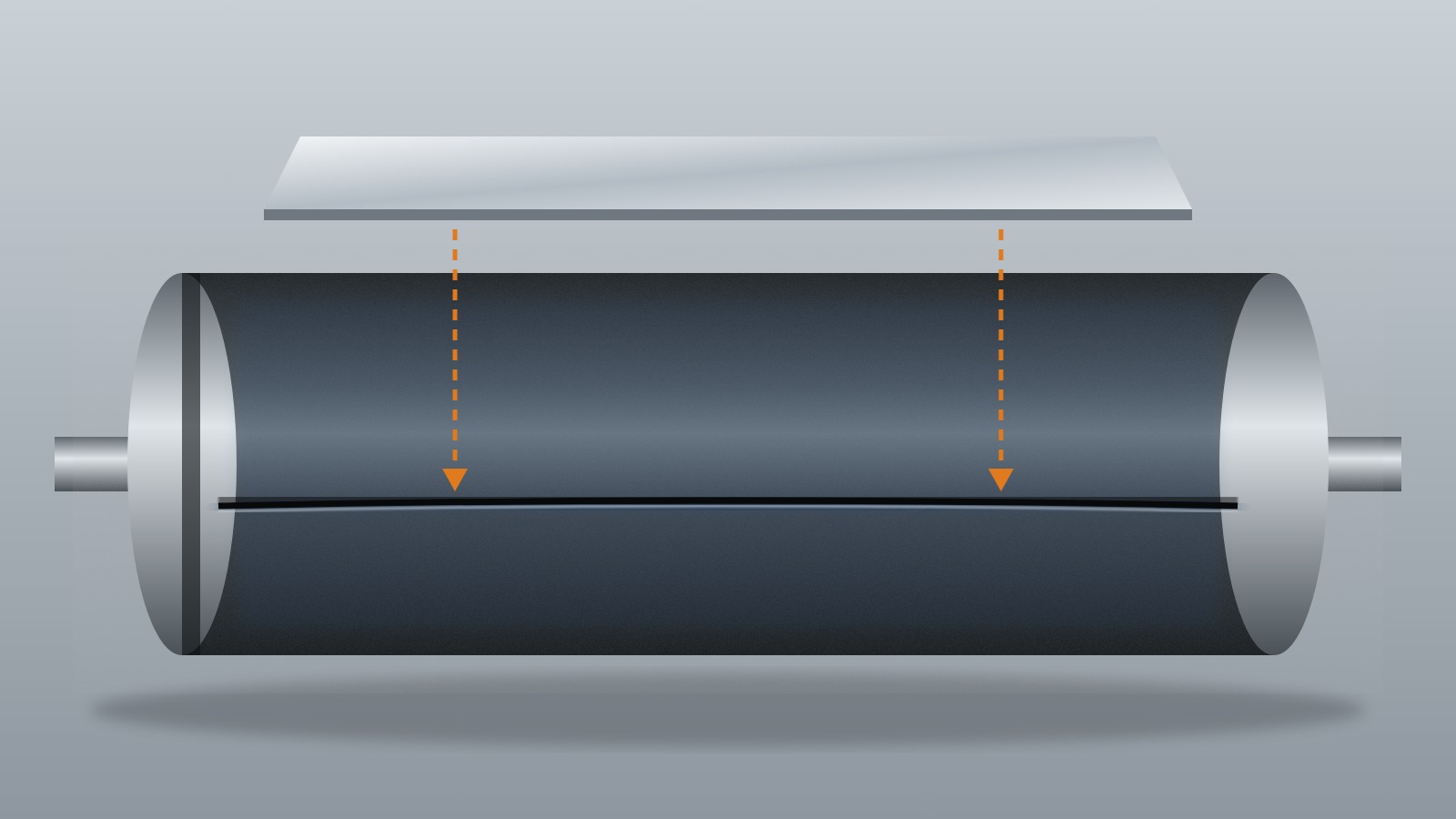
The trouble starts when you change jobs. Put a larger sheet on, and that line now prints as a light band through your solid, so the blanket comes off even though the rest of it is fine.
Blankets built for metal have a tougher face and handle edge impact better than paper blankets, especially on long repeat runs.
Still, a blanket can’t make up for bad sheets. Check the shear, burrs, packing height, and squeeze first. We’ve seen plenty of cases where a brand-new blanket marked just as quickly as the old one, and the actual cause was a shear blade overdue for regrinding.
Dense solids and fine detail on a non-porous surface
Metal decorating asks a lot here. You need heavy, even solids on a surface that absorbs nothing: opaque whites, brand colours, big background panels, without pinholes or mottling. On the same sheet, small reverse text and fine tints have to stay open.
The face compound, surface finish and compressible build decide:
- your solid ink density, and how even it is across the sheet
- how well halftones and fine lines hold
- how much dot gain you get, and whether reverse text stays clear
- whether you get smearing or back-trapping
- how cleanly the sheet lets go of the blanket
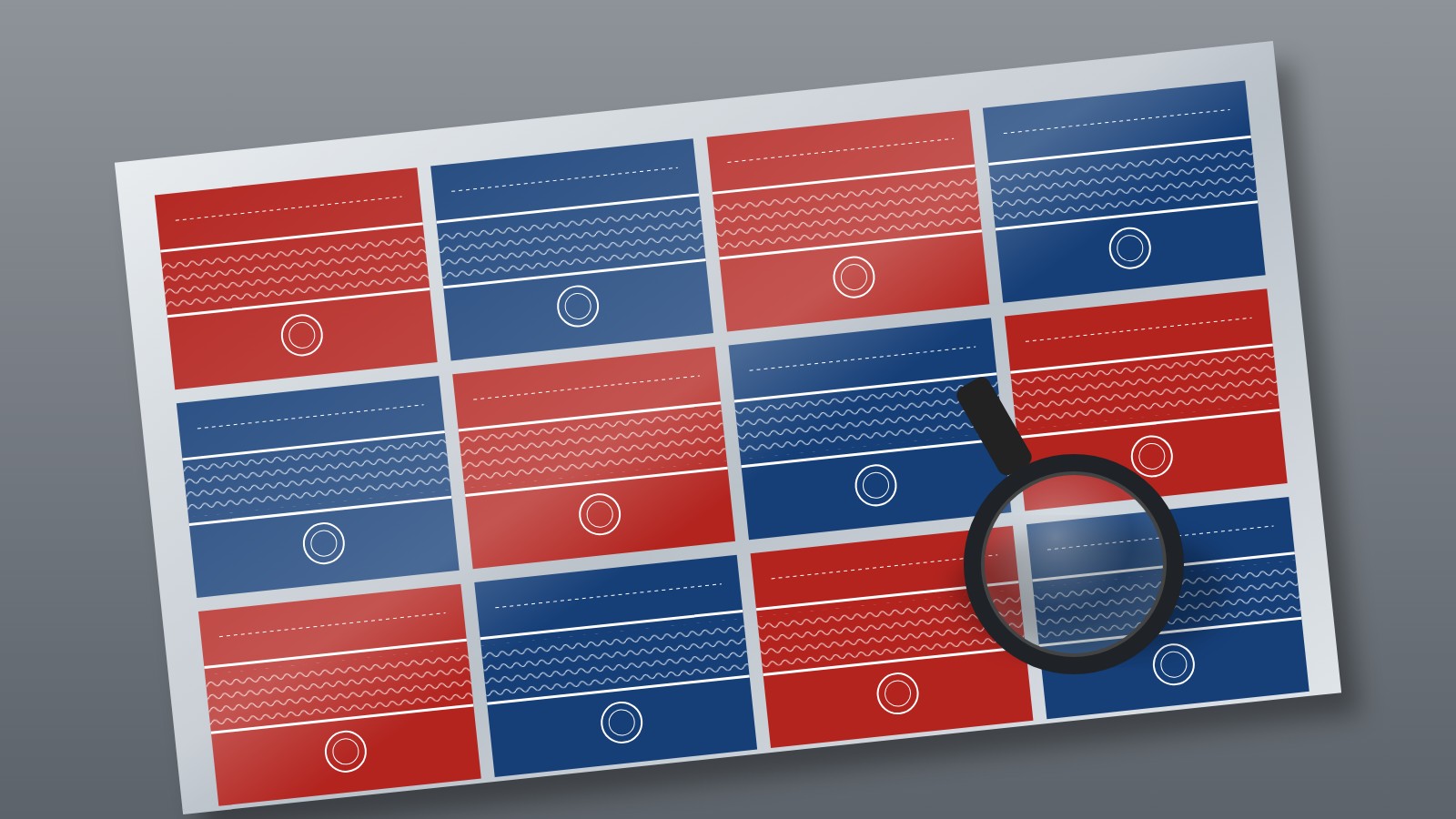
In practice, there’s no point pushing for a stronger white if the reverse type on the ingredients panel closes up.
Can one blanket run both conventional and UV metal inks?
Usually not, at least not reliably. Conventional and UV or LED-UV metal inks put different chemicals in contact with the rubber. A compound that’s fine with one can swell, harden, or stop transferring properly with the other. Pick the blanket for the ink, wash and curing setup you actually use, then prove it on press.
Before you order, ask the supplier to confirm that the blanket suits:
- your conventional, UV or LED-UV inks
- the whites, varnishes and any special colours you run
- every blanket and roller wash used on that press
- your running speed and curing setup
- how often your crew washes the blanket
Don’t go by the word “UV” on the label or the colour of the rubber. Go by the manufacturer’s recommendation for your full set of chemicals, then a trial on your press.
A word on surface finish
Surface finish affects ink lay-down, fine detail and sheet release. Most metal blankets have a micro-buffed face for even transfer across solids and halftones.
There’s no single right roughness. UV-dedicated blankets often have a smoother face and a softer load profile than blankets meant for conventional inks. That’s one reason two blankets both sold for metal decorating aren’t necessarily interchangeable.
Paper vs metal printing blanket: side-by-side comparison
If your purchase team wants the short version, here it is.
The key differences between a paper blanket and a blanket built for tinplate.
| Selection factor | Paper and board blanket | Tinplate and metal decorating blanket |
|---|---|---|
| Substrate behaviour | Flexible, usually absorbent | Rigid, non-porous |
| Main mechanical demand | Controlled impression across paper grades | Full recovery under rigid impression, plus resistance to sheet-edge stress |
| Transfer priority | Balanced dots, solids and sheet release | Dense, even solids with clean fine detail and no smearing |
| Sheet-edge risk | Generally low | High, especially with sharp or burred edges |
| Release requirement | Prevent picking, support clean transport | Quick, clean release from a smooth, non-absorbent sheet |
| Chemical match | Conventional or UV paper inks and washes | The exact conventional or UV metal ink, varnish and wash system |
| Construction | Chosen for press and paper application | Purpose-built: tough face, stable compressibility, metal-compatible compound |
What to look for in a metal decorating blanket’s datasheet
Read the values together, and check both suppliers tested to the same standard; otherwise you’re not comparing like with like.
Load/indentation value
The force needed to press the blanket down by a set amount. For tinplate it’s one of the most useful figures, because it shows how the blanket behaves in a hard nip.
Thickness (gauge)
It has to match your press and packing spec. On tinplate, also ask how well it holds gauge through a run, because when gauge drops, density follows.
Ply construction
The fabric plies are the backbone. They stop the blanket stretching and keep image size steady, which matters when registering several colours on metal.
Compressible layer type
Usually closed-cell microspheres on metal blankets. This layer absorbs impression variation and recovers, so it’s your main defence against edge marks and low spots.
Surface roughness (Ra)
Ra tells you how fine or coarse the face texture is, which affects ink transfer, solids, detail, and release. Don’t judge it alone; the right value depends on compound, load profile, and ink.
Micro-hardness (IRHD)
How hard the face is at the surface. Harder tends to hold detail and resist edge damage; softer helps solids cover. Metal usually needs something in between.
Elongation
How much the blanket stretches under tension. Low, stable stretch means less re-tensioning and steadier register.
Tensile strength
The load the blanket takes before it fails, showing whether the carcass can cope with bar tension and rigid sheets.
Common problems and likely causes
It’s tempting to blame the blanket first. Often the cause is elsewhere, so work through this list with your operators.
| Symptom | Likely blanket-related cause | Other causes to check |
|---|---|---|
| Edge mark where the sheet edge lands | Face not resistant to edge cutting; compressible layer losing recovery along that line | Sheet burrs or poor shearing; excess squeeze; packing too high; same sheet size run for long periods |
| Weak or patchy solids, whites not covering | Glazed face; gauge loss or low spots; load profile wrong for the job | Packing below spec; low ink film; worn or badly set rollers |
| Smearing or slurring | Swollen or tacky face; poor sheet release | Excess pressure; ink too soft or too heavy; sheet transport and gripper issues |
| Reverse text filling in, high dot gain | Face swollen by ink or wash; load profile too soft | Over-packing; excess ink or dampening; plate condition |
| Blanket swelling or going tacky | Compound not compatible with the ink or wash | Wrong wash; wash left on the blanket; UV and conventional products mixed on one press |
| Short blanket life, frequent low spots | Compressible layer fatigue; weak carcass | Over-packing; sheet doubles or smashes; incorrect bar tension |
Seeing one of these now? WhatsApp a photo of the blanket and a printed sheet to +91 93550 08876, and we’ll help you work out whether it’s the blanket, the setting or the sheet.
A 9-point checklist before you order an offset printing blanket for tinplate
Use it to compare quotes on equal terms or to brief a supplier.
- Printing process: sheetfed litho metal decorating, dry offset can printing, or something else?
- Press and blanket size: exact press model, bar type, thickness, and packing spec.
- Inks and curing: conventional, UV or LED-UV, including whites, varnishes and special colours.
- Type of work: mostly heavy solids, fine halftones, small reverse text, or a mix of all three.
- Metal: tinplate, TFS, aluminium,m or something else, plus gauge and sheet quality.
- Surface and load values: compare the whole construction, not just thickness or hardness.
- Sheet edges: if you already get edge marks, check burrs and shearing first.
- Washes: list every blanket and roller wash used on the press.
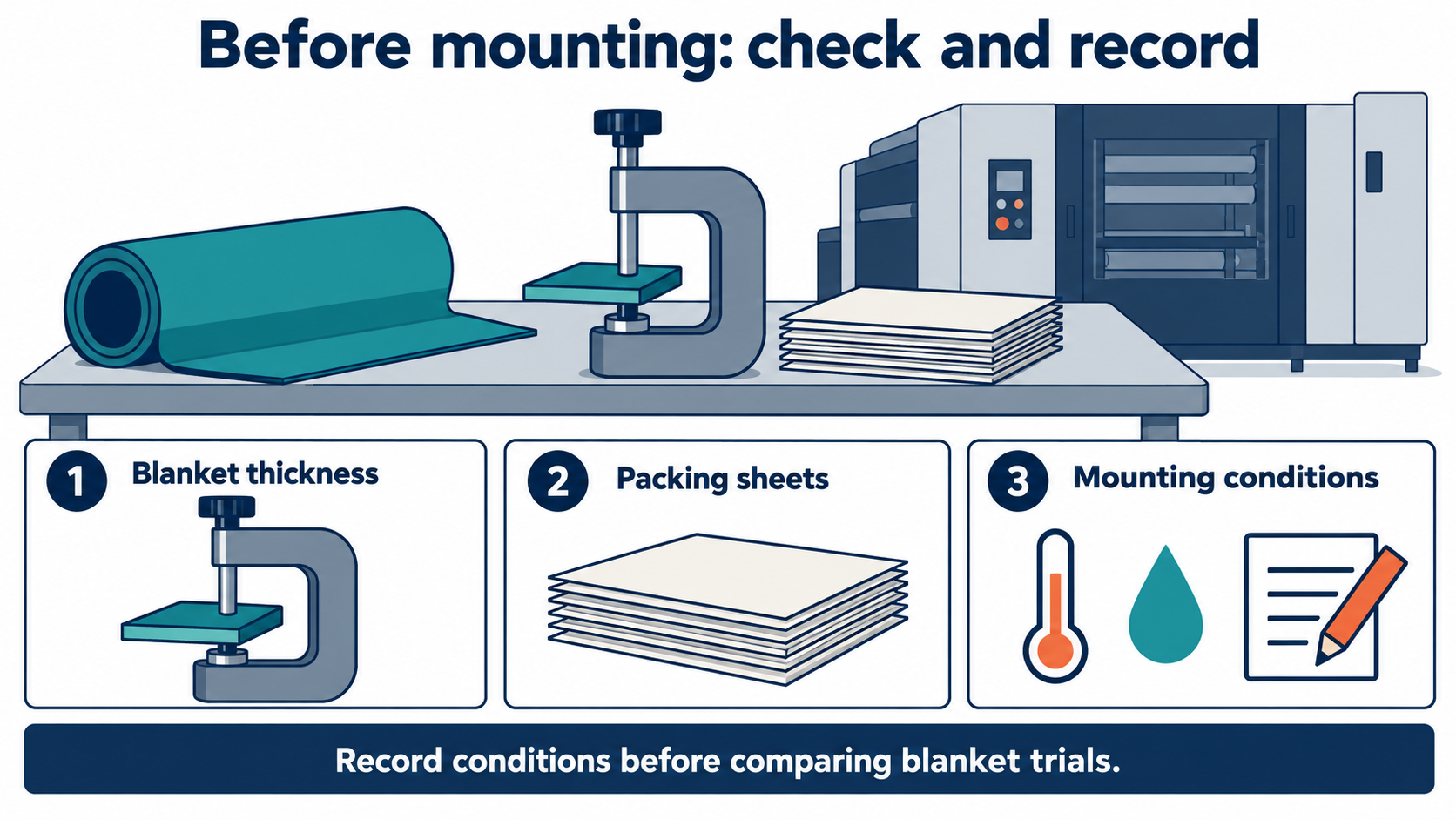
- Trial plan: record density, dot gain, reverse detail, smearing, release and blanket condition over a real production run.
What a blanket really costs you
On the purchase order, a standard paper blanket looks cheaper. On the press, it marks early, solids wander, the white needs another pass, and the press stops more for blanket changes. The saving is usually gone within weeks.
A fairer comparison is the whole running cost:
- how many impressions you get from it (not how many months)
- make-ready time and waste sheets every time you change one
- extra ink, including second passes for opacity
- wash-up time and unplanned stoppages
- rejects that get as far as your customer
An offset blanket for metal printing that costs more up front but runs longer and holds quality will usually work out cheaper per thousand good sheets. The same thinking applies to most of your tin can printing consumables.
When you’re choosing an offset printing blanket for tinplate, go by the full datasheet and a proper trial on your own press, and judge it on cost per good sheet rather than price per piece.
Not sure which blanket suits your line?
Send us your press model, blanket size, ink type (conventional, UV, or LED-UV), and what’s going wrong, whether that’s weak solids, smearing, edge marking, or short blanket life. We’ll come back with a free recommendation and, if it makes sense, talk about a trial on your press.
FAQ
What’s the difference between a paper and a metal printing blanket?
Paperboard is flexible and generally more absorbent, while tinplate is rigid, smooth and non-porous. A paperboard blanket is selected mainly for accurate image reproduction and clean transfer across different board surfaces. A tin printing blanket must also provide stable recovery, strong solid-ink transfer, quick sheet release and resistance to damage from metal sheet edges.
Can I use the same blanket for UV and conventional metal inks?
Usually not, unless the blanket manufacturer specifically approves it for both ink systems. Conventional and UV/LED-UV inks and washes can affect the rubber differently. Choose a blanket compatible with your inks, washes and curing setup, then confirm its performance through a press trial.
Why is compressibility more critical when printing on tinplate?
Tinplate does not conform to the printing nip like paperboard. The blanket must therefore manage more of the impression variation and recover consistently after every revolution. Stable compressibility helps maintain even ink density and image reproduction while reducing the risk of permanent impression lines, low spots or gauge loss.
Which blanket properties improve solid-ink coverage on tinplate
The face compound, surface finish, compressible construction, loading characteristics and sheet-release behaviour all affect transfer. A suitable tin printing blanket should produce dense, uniform solids without pinholes or smearing while keeping fine lines, halftones and small reverse text clean and open.
How do I stop edge marks on a tin plate printing blanket?
Start with the sheets: check the shear and look for burrs. Then check packing height and squeeze. If those are all right, a blanket with better edge resistance and steadier recovery will help, and varying the sheet size between long runs spreads the wear.
Is a softer blanket better for tinplate?
Not necessarily. Softer can help solids cover, but go too soft and dots spread and reverse text fills in. What you want is a balance between solid coverage, detail and edge resistance that suits your press and your usual jobs.
How long should a blanket last on a metal decorating press?
There’s no single answer, because it depends on press condition, packing, sheet quality, inks and how the blanket is washed. The most useful thing you can do is log blanket life in impressions and note why each one came off. That record makes comparing two blankets far fairer.
What should I tell a supplier to get the right blanket?
Your press model, blanket size and bar type, the inks and curing system, the washes you use, the metal you print on and the problem you’re trying to fix. A couple of photos of a used blanket and a printed sheet help a lot.
Does Remedium help with tin can printing consumables?
Yes. We work with tin container and metal packaging printers on blanket selection and other tin can printing consumables. Call or WhatsApp +91 99110 05168, or email growth@remedium.co.in, and we’ll give you a free recommendation.