

The Real Debate in the Pressroom
If you are still running inline coating on old, stripped rubber blankets, you may be losing money on every repeat job. Dedicated coating plates, especially photopolymer or polyester-backed varnishing plates, provide stronger registration stability, cleaner spot edges, and much longer usable run lengths than fabric-layered rubber blankets.
For packaging printers and commercial finishing managers, choosing between a coating blanket and a coating plate is not just a technical decision. It affects make-ready waste, wash-up frequency, and total cost per thousand impressions over the life of a job.
The usual discussion sounds familiar. One team says, “We already have old offset printing blankets; strip them and use them in the coating unit.” The other argues for a dedicated coating plate that can be stored and reused on repeat work. The right answer depends on the job, but for long-run and repeat packaging work, the numbers increasingly favor the dedicated plate.
- Makeready time and substrate waste
- Registration accuracy on repeat jobs
- Wash-up frequency and solvent use
- Operator time and press availability
- Total coating cost per 1,000 impressions
Dimensional and Registration Stability
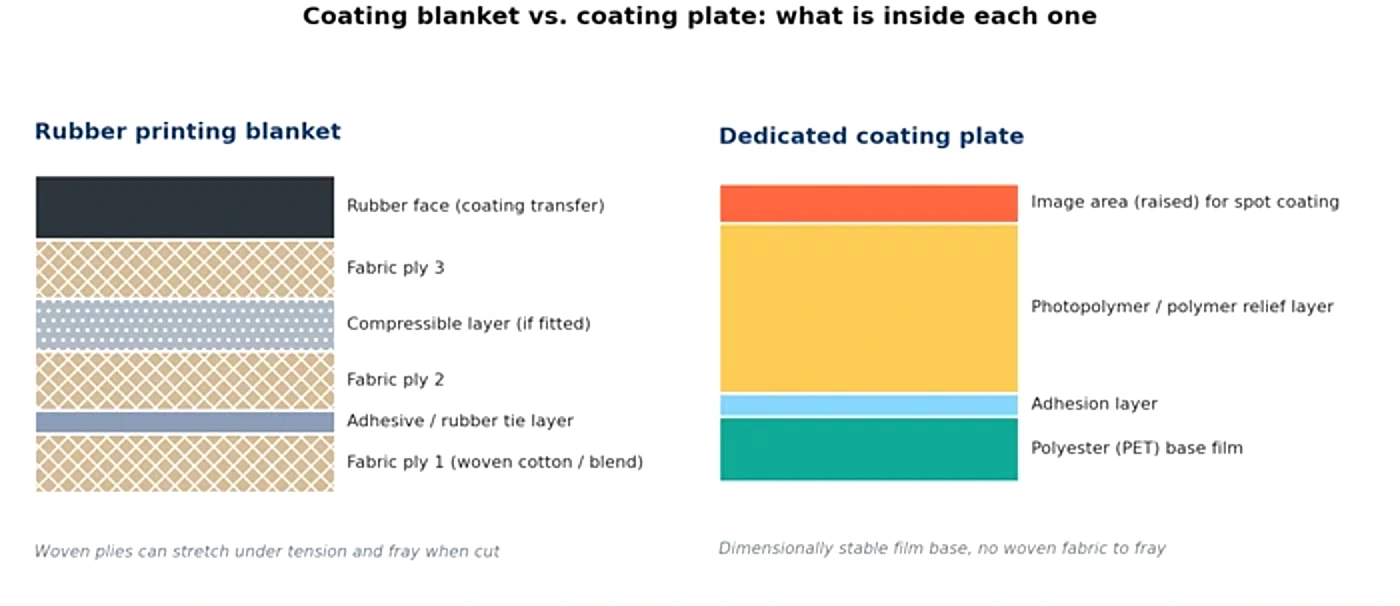
A conventional offset printing blanket is a layered product. It normally includes a woven fabric base, a compressible rubber layer, and a printable surface. That construction is useful for ink transfer in offset printing, but it can work against you when the blanket is cut and used for selective coating.
Even after a printing blanket is stripped for coating, the fabric-and-rubber construction can respond to tension, heat, and repeated mounting. The result can be a small change in repeat length or spot position. On a simple flood coat, that may not matter. On a carton with a spot varnish window, metallic graphics, or a tight die-line relationship, it can quickly become a quality issue.
- Slight changes in repeat length during a long run
- Registration drift on spot varnish or spot UV coating
- More time spent correcting register on repeat orders
- Greater risk of coating falling outside a critical design area
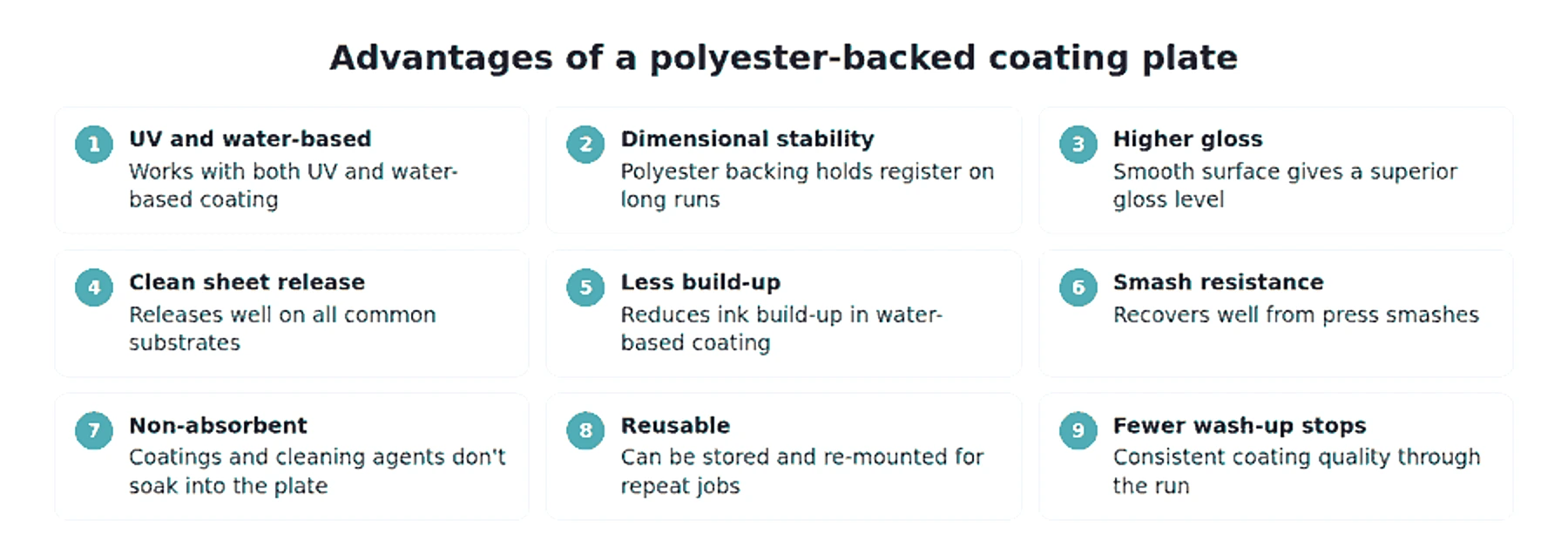
A dedicated coating plate uses a more stable construction, commonly a photopolymer surface on a polyester or metal-backed carrier. It is designed to hold its dimensions during mounting and running. Once the plate is registered, it can usually be removed, stored, and remounted for a repeat job with far less adjustment.
For an inline coating unit, that stability means fewer make-ready sheets and a more predictable setup. It also gives production teams more confidence when a customer reorders the same premium package months later.
Cutting Precision: Why Edge Quality Matters
Spot coating lives or dies by edge definition. A coating blanket may look economical until it is cut. The intermediate fabric layer in many rubber blankets can leave a frayed edge. Those fibers can hold coating and ink, creating build-up around the edge of the image.
That build-up can cause a halo, a ragged outline, or coating where it does not belong. On dark solids, foil-board packaging and high-gloss work, the defect is especially visible. The operator then has to stop, clean, reset, and run additional sheets to verify the finish.
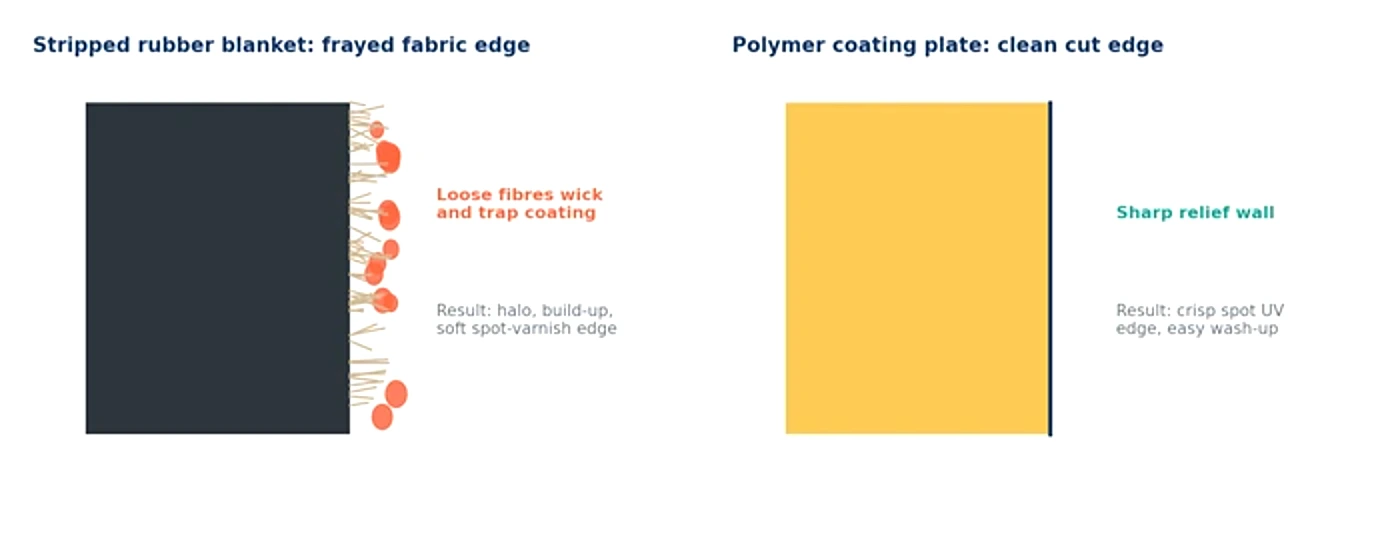
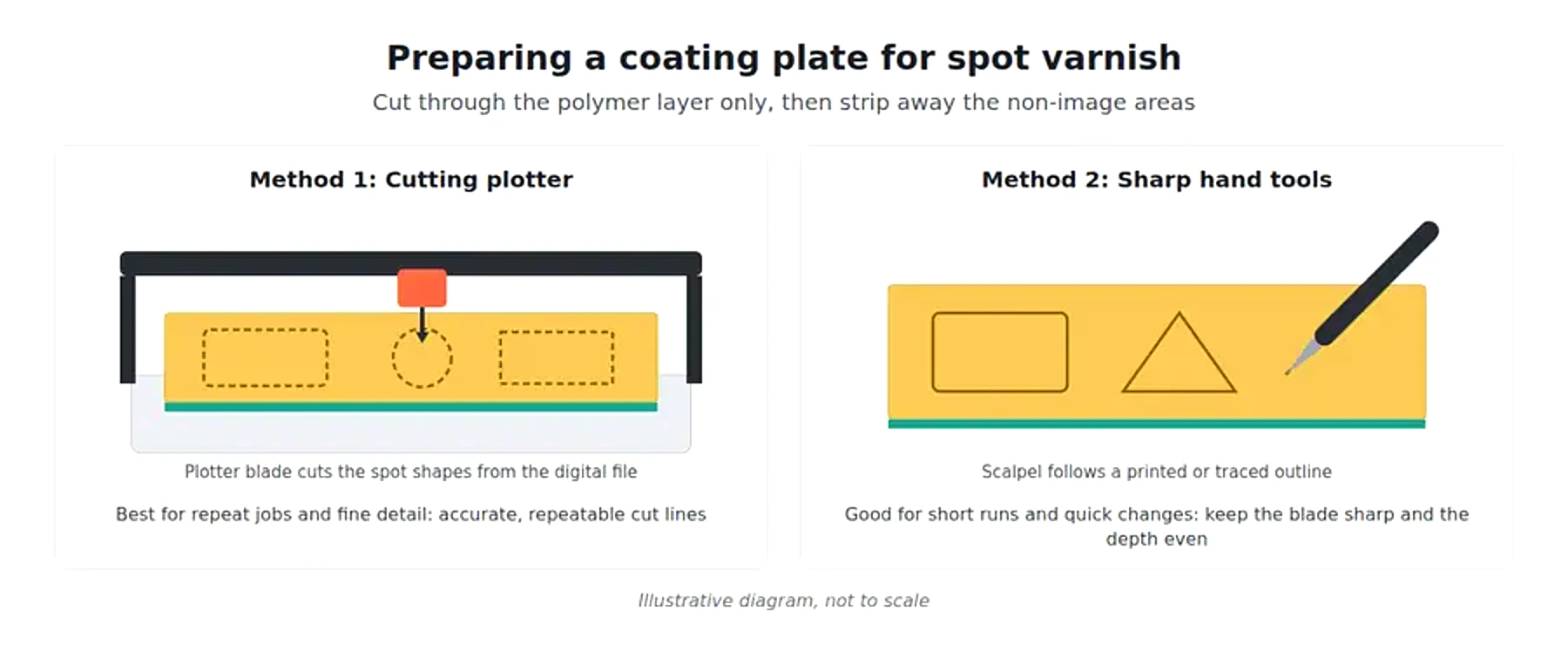
A polymer coating plate cuts cleanly because it has no woven fabric layer to fray. It can be imaged, laser-cut, or die-cut for precise spot shapes. The edges remain smoother, helping the coating transfer cleanly and keeping non-image areas cleaner.
- Crisper spot varnish boundaries
- Cleaner spot UV coating shapes
- Less coating trapped around image edges
- Reduced risk of halos and contamination
- More consistent premium finish across the job
For brand-sensitive packaging, clean edges are not a minor aesthetic detail. They are part of the perceived value of the finished product.
Run-Length ROI: The Difference Adds Up
The initial price of a coating blanket can look attractive, particularly if it is an old printing blanket that appears to have no remaining value. However, the purchase price is only one line in the true cost of inline coating.
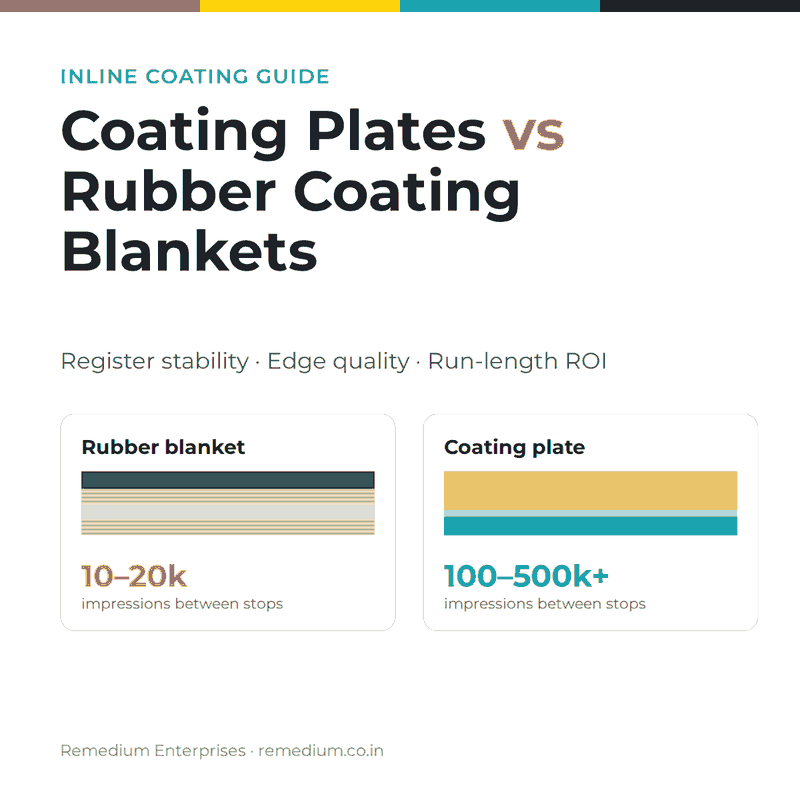
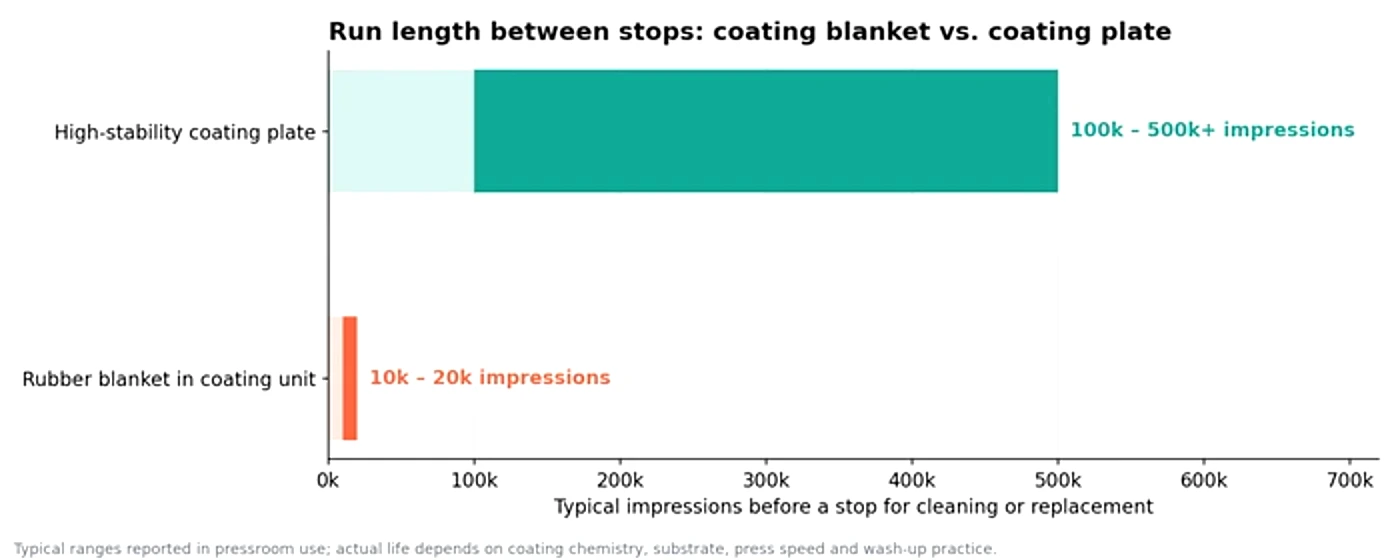
Rubber blankets used for coating can begin to collect ink and coating relatively quickly. In many pressrooms, the practical limit is around 10,000 to 20,000 impressions before cleaning, adjustment, or replacement becomes necessary. The actual result depends on the coating chemistry, substrate, press condition, and job design, but the interruption itself is the cost driver.
Dedicated coating plates are built for repeatability and long runs. High-stability varnishing plates can often run 100,000 impressions or more without the same level of build-up. When cleaned, stored, and handled correctly, some plates can be reused across repeat jobs for 500,000 impressions or more.
- Fewer wash-ups during longer production runs
- Less solvent use and fewer cleaning consumables
- More available press time for billable work
- Less waste after stopping and restarting
- Lower cost per run when the plate is reused
The key question is not, “What does the blanket cost today?” It is, “What does the job cost after every wash-up, register correction, wasted sheet, and repeat setup?”
A Practical Cost Scenario
Consider a packaging customer that orders the same carton four times per year. Each order is 100,000 impressions and includes a registered spot varnish or spot UV coating feature.
With a rubber coating blanket, the press may require several coating cleanups during each order, plus additional time to correct registration when the blanket is reused. The job may also consume more setup sheets as operators chase edge quality and coating density.
With a dedicated coating plate, the plate is mounted, registered, and run. For a repeat order, it can be retrieved from storage and remounted with much less register correction. Spread across four 100,000-impression orders, the upfront plate investment can be divided across 400,000 impressions rather than charged to one job.
The exact savings depend on your hourly press cost, substrate value, labor rate, and wash-up time. But the business case becomes stronger as run length, repeat frequency, and registration sensitivity increase.
Why Worn Printing Blankets Create Hidden Costs
Using an old offset printing blanket in a coating unit can seem practical: the material is already in the plant, and its printing life is over. But a worn blanket brings wear patterns into the coating process.
- Surface scratches and glazing can create uneven coating transfer
- Compression set and thickness variation can affect pressure and coating film weight
- A worn surface may encourage faster coating or ink build-up
- Stretch and deformation can make repeat registration less predictable
- Poor finish quality can lead to rejected sheets, rework, or customer complaints
A coating unit is not a place to use whatever is left over from printing. It is a finishing station that directly affects gloss, tactile appearance, and the shelf impact of the product. The image carrier needs to match that responsibility.
When a Rubber Coating Blanket Makes Sense
A rubber coating blanket is not automatically the wrong choice. It can be a sensible option when the job is very short, will not be repeated, and uses flood coating rather than a tightly registered spot design.
- Very short, one-time jobs
- Full flood coating where edge precision is not critical
- Low-risk work with limited finish requirements
- A purpose-built coating blanket designed specifically for varnish or UV applications
The important distinction is between a quality coating blanket designed for the job and a worn or stripped offset printing blanket pressed into service. The latter often creates more problems than it solves.
Recommendations for Printing Managers
- Stop treating stripped, worn printing blankets as a default coating solution. Their fabric layers, surface wear, and stability limitations can affect both finish quality and productivity.
- Standardize on photopolymer or polyester-backed coating plates for registered spot work. They are better suited to spot varnish, spot UV coating, and repeat packaging applications.
- Track cost per run rather than only material price. Include wash-ups, setup sheets, operator time, solvents, press downtime, and repeat-job register adjustments.
- Store and label coating plates for repeat business. A plate with a clear job reference, date, and handling record is an asset that can shorten future make-ready.
- Run a controlled pilot on one repeat packaging job. Compare a blanket and a dedicated coating plate using the same design, coating, substrate, and press settings.
What to Measure in Your Pilot
- Makeready sheets used
- Time to achieve acceptable register
- Number and duration of wash-ups
- Coating defects or rejected sheets
- Total operator and press time
- Repeat-job setup time
- Final cost per 1,000 impressions
This kind of comparison turns a theoretical debate into a practical purchasing decision. Once teams see the actual cost of stops, waste, and rework, they can evaluate coating plates and coating blankets on the same basis.
Contact us to learn more about how coating plates can help you improve your productivity.